
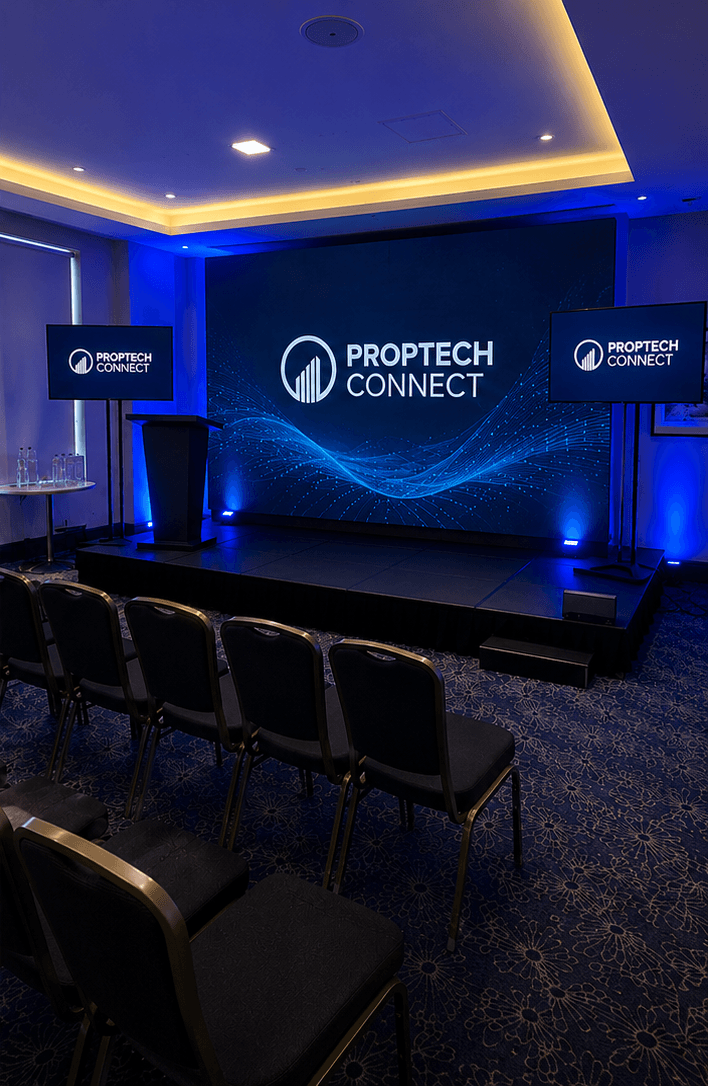
Choosing between an LED screen and a projector might seem like a fairly simple part of planning an event. In reality, it can make a huge difference to how professional your presentations, videos and branding look on the day.
Both options can work extremely well. The right choice depends on the venue, audience size, lighting conditions, content you want to display and, of course, your budget.
For a small corporate meeting in a controlled environment, a projector and screen may be all you need. For a product launch in a bright London venue, an LED screen could produce a much stronger result.
So how do you decide?
In this guide, we explain the differences between LED screen hire and projector hire, where each option works best and what event organisers should consider before making a decision.
LED Screens vs Projectors: What’s the Main Difference?
The biggest difference is how the image is produced.
A projector throws an image onto a separate projection surface or screen. This means the final image quality is affected by the projector itself, the projection distance, the screen and the amount of ambient light in the room.
An LED screen creates the image directly from thousands of individual LEDs. There is no projected beam and therefore no requirement for a darkened room or clear projection path.
This is one of the reasons LED displays have become increasingly popular for conferences, exhibitions, awards ceremonies and corporate events.
But that doesn’t mean a projector is the inferior option.
For the right event, projection remains an extremely practical and cost-effective solution.
When Is an LED Screen Better?
LED screens tend to be the stronger choice when image impact and brightness are particularly important.
Bright venues
This is probably the biggest advantage.
If you’re holding an event in a room with large windows, daylight or strong venue lighting, projected images can sometimes appear washed out.
LED screens generate their own light, so they remain bright and clear in environments where projection can struggle.
This is particularly useful in modern London offices, atriums, exhibition halls and venues with floor-to-ceiling glazing.
Large conferences
At a large conference, people sitting at the back of the room need to see exactly the same presentation as delegates sitting near the stage.
A suitably sized LED screen can provide a bright, high-contrast image that remains easy to view across a large room.
For larger productions, multiple screens can also be incorporated into the event design.
Product launches
If the screen is a major visual feature of the event, LED often makes sense.
A large LED wall can display:
- Product videos
- Brand animations
- Speaker presentations
- Live camera feeds
- Sponsor content
- Event graphics
- Countdown sequences
- Social media content
Rather than simply being somewhere to display PowerPoint slides, the screen can become part of the overall stage design.
Exhibitions
LED screens can also work extremely well on exhibition stands.
Movement naturally attracts attention in a busy exhibition hall, so displaying high-quality video and animated brand content can help a stand become more noticeable.
Awards ceremonies and gala events
Large LED walls are frequently used as stage backdrops for awards events.
They can display category graphics, nominee information, winner announcements, sponsor branding and video content without requiring physical backdrops to be changed throughout the evening.
When Is a Projector Better?
Projection still has a major role in professional events and can be the better option in many situations.
Smaller meetings and presentations
For board meetings, training sessions, seminars and smaller conferences, a projector and screen can provide everything required.
If you’re mainly showing PowerPoint slides, charts, documents or occasional videos, there may be little benefit in installing a large LED wall.
Controlled lighting environments
Projection performs best when room lighting can be controlled.
Conference rooms, hotel meeting suites and dedicated presentation spaces are often ideal.
If curtains or blinds can reduce daylight and the lighting around the projection screen can be controlled independently, a high-quality projector can produce an excellent image.
Budget-conscious events
Projection is often less expensive than building a large LED display.
LED walls require multiple panels, processing equipment, supporting structures and additional installation time.
For straightforward presentations, spending more on LED may not provide enough additional benefit to justify the cost.
A professional AV company should recommend what the event actually requires rather than automatically specifying the most expensive option.
LED Screen vs Projector: Brightness
Brightness is one of the most important considerations.
LED screens generally perform better in bright environments because the image is produced directly by the display.
Projection works differently.
Light travels from the projector to the screen and is reflected back towards the audience. Other light entering the room competes with the projected image.
This is why a projector that looks excellent in a dark conference room can appear much weaker when used in a bright venue.
However, projector technology has improved significantly, and high-output professional projectors can still perform very well when correctly specified.
The important thing is choosing equipment based on the actual venue rather than simply comparing specification sheets.
Image Quality
Both technologies are capable of excellent image quality.
LED displays tend to provide:
- Strong brightness
- High contrast
- Rich colours
- Excellent visibility
- Consistent images in changing lighting conditions
Projection can provide:
- Very sharp presentations
- Excellent video reproduction
- Large image sizes
- Smooth images at appropriate viewing distances
The quality of either system depends heavily on the equipment used and how it has been configured.
A cheap projector positioned incorrectly will perform poorly.
Likewise, an LED wall with the wrong pixel pitch for the audience viewing distance may not produce the result you expect.
What Is LED Pixel Pitch?
If you’re considering LED screen hire, you may hear the term pixel pitch.
Pixel pitch is the distance between individual pixels on an LED panel, normally measured in millimetres.
A smaller pixel pitch generally allows the audience to stand closer to the display while still seeing a smooth image.
For example, an LED screen being viewed from relatively close range at a corporate conference may require a finer pixel pitch than a large display positioned much further from the audience.
This is why simply asking for “a large LED screen” isn’t enough.
The AV supplier needs to understand the dimensions of the room and where the audience will be positioned.
How Large Does the Screen Need to Be?
Screen size should be determined by the viewing distance and the type of content being displayed.
A common mistake is choosing a screen based purely on the stage dimensions.
Instead, think about the person sitting furthest away.
Can they comfortably read:
- Presentation text?
- Financial figures?
- Graph labels?
- Speaker names?
- Subtitles?
- Sponsor logos?
If not, the screen is too small regardless of how good it looks from the front row.
For particularly wide rooms, it may make more sense to use two screens rather than one extremely large central display.
Venue Ceiling Height Matters Too
Screen width isn’t the only consideration.
You also need sufficient height.
In conference environments, the bottom of the display needs to be high enough that delegates can see it above the people sitting in front of them.
This becomes particularly important for audiences seated at round tables.
A site survey can help determine the correct screen dimensions and positioning before equipment is specified.
Front Projection vs Rear Projection
If you choose projection, there are two common approaches.
Front projection
The projector sits on the audience side of the screen.
This is usually simpler but requires a clear projection path.
Someone walking through the beam can temporarily cast a shadow across the screen.
Rear projection
The projector sits behind a specialist screen and projects forward towards the audience.
This keeps the projector and projection beam away from guests and can produce a very clean-looking stage.
However, you need sufficient space behind the screen.
In London venues where every metre of floor space matters, this isn’t always possible.
LED Screens Require Less Projection Distance
One significant advantage of LED is that there is no projector sitting several metres away from the screen.
This can be particularly useful in awkward venues.
If the room is relatively shallow, has low ceilings or doesn’t provide suitable projector positions, LED may solve several practical problems.
However, LED walls themselves require appropriate structural support and installation space, so they aren’t completely free of venue constraints.
What About Speaker Presentations?
For presentations containing detailed text, spreadsheets and graphs, clarity is extremely important.
The AV team should know the resolution and aspect ratio of the display system before the presentation is finalised.
Most modern presentations use a 16:9 widescreen format, but this should always be confirmed.
It is also worth testing presentations before guests arrive.
Nothing looks less polished than a presentation suddenly appearing stretched, cropped or surrounded by unexpected black borders.
Live Camera Feeds
For larger conferences, awards events and panel discussions, cameras can be used to show presenters on the main screens.
This is sometimes referred to as IMAG, or image magnification.
For example, a delegate sitting 30 metres from the stage may struggle to see a speaker’s facial expressions.
Displaying the live camera feed on large screens solves this problem.
Both LED screens and projection systems can be used for live camera feeds.
Branding Opportunities
LED displays offer particularly strong opportunities for event branding.
Instead of having a blank screen between presentations, you can continuously display:
- Company branding
- Event logos
- Sponsor graphics
- Agenda information
- Animated backgrounds
- Speaker introductions
- Social media handles
This can make the whole production feel much more polished.
What About Outdoor Events?
Outdoor projection can be challenging, particularly during daylight.
Even powerful projectors have to compete with natural light.
Outdoor-rated LED screens are usually much more appropriate when content needs to remain visible during daytime outdoor events.
Outdoor equipment must also be correctly rated and installed for weather exposure.
An indoor LED screen should never simply be moved outside because the weather forecast looks favourable.
Installation Time
A projector and screen can generally be installed relatively quickly, particularly for a straightforward meeting or conference setup.
A large LED wall requires more work.
Individual LED panels need to be assembled, connected, tested and configured. The structure supporting the display also needs to be installed safely.
For large productions, this can significantly affect venue access and setup times.
When planning an event in London, this is particularly important because many venues operate strict loading and access windows.
Cost: LED Screen Hire vs Projector Hire
There isn’t one fixed price difference.
Costs depend on factors including:
- Screen dimensions
- LED pixel pitch
- Projector brightness
- Projection screen size
- Installation requirements
- Rigging
- Venue access
- Event duration
- Number of technicians
- Video processing
- Delivery and collection
- Additional cameras or presentation equipment
As a general rule, a straightforward projector and screen setup is usually more economical than a large LED wall.
However, price should be considered alongside the environment and the importance of the screen.
Saving money on the display isn’t particularly helpful if half the audience can’t clearly see the presentation.
Can You Use LED Screens and Projectors Together?
Absolutely.
Larger events frequently use a combination.
For example, an event might have:
- A large central LED wall behind the stage
- Projection screens on either side
- Confidence monitors for presenters
- Television displays in breakout rooms
- Digital signage in reception areas
The aim isn’t to choose one technology for the entire event.
It’s to use the most appropriate display in each location.
Questions to Ask Before Choosing
Before deciding between an LED screen and projector, establish:
- How many people are attending?
- How large is the room?
- How far away is the furthest audience member?
- How much daylight enters the venue?
- Can the room lighting be controlled?
- What type of content will be displayed?
- Will there be live cameras?
- How much stage space is available?
- Is there room for rear projection?
- What are the venue’s loading and setup restrictions?
- Will the display be used indoors or outdoors?
- What budget has been allocated to AV?
These questions normally make the right solution much clearer.
LED Screen or Projector: Which Should You Choose?
There isn’t a universal winner.
Choose an LED screen when:
- The venue is bright
- Visual impact is important
- You’re creating a large stage production
- The display forms part of the event branding
- You’re running an exhibition or product launch
- You need excellent visibility in changing lighting conditions
- Projection distance is limited
Consider projection when:
- You’re organising a smaller meeting or conference
- Lighting can be controlled
- The content is mainly presentations
- Budget is important
- There is suitable projector positioning
- You need a straightforward and effective display solution
For some events, a combination of both will provide the best result.
Professional LED Screen and Projector Hire in London
The most important decision isn’t necessarily LED versus projection. It’s specifying the right system for the room.
At AV Hire London, we can assess your venue, audience size, presentation requirements and event format before recommending the appropriate display solution.
We provide professional LED screen hire, projector hire and complete AV hire across London, alongside sound systems, microphones, lighting, staging, video equipment and technical support.
Whether you’re organising a small corporate presentation, a conference, exhibition, awards ceremony or large-scale event, we can design an AV setup around your venue rather than simply supplying equipment from a standard package.
If you’re unsure whether an LED screen or projector is right for your event, send us your venue, event date, audience size and a brief description of what you’ll be displaying, and our team can recommend a suitable setup.