
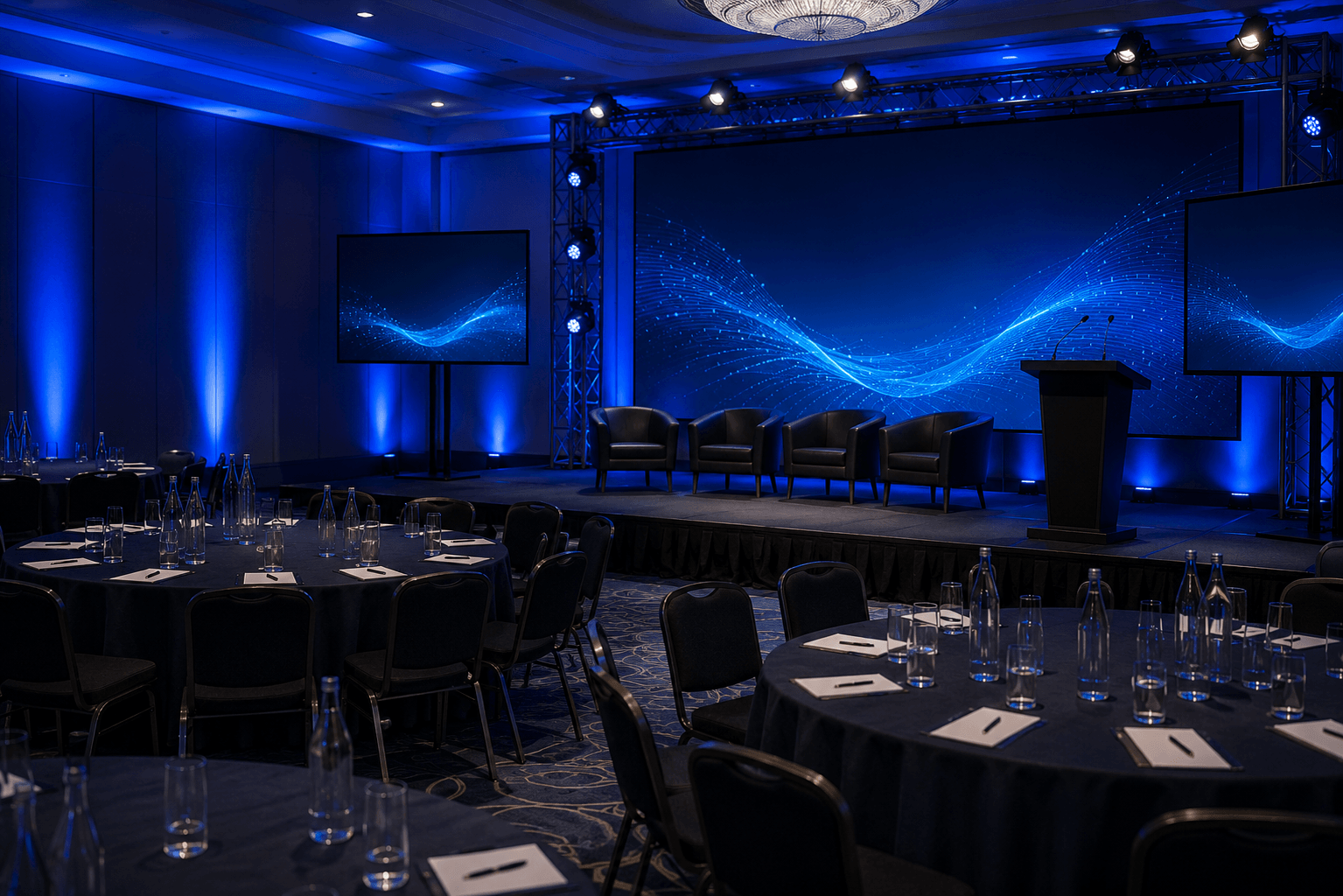
An AGM is not a conference. The audience is not there to learn. They are there to participate in a formal process, ask questions, vote on resolutions, and hold the board to account. The AV setup needs to support all of that, not just make the presentation look good.
A lot of companies treat their AGM like a scaled-down conference and end up with a setup that does not quite fit. The microphone arrangement is wrong for shareholder questions. The voting process is handled by a show of hands because nobody planned for anything better. The audio is fine for the front rows but drops off at the back.
This guide covers what an AGM actually needs from an AV perspective and why some of those requirements are specific to this format.
What makes an AGM different
Three things separate an AGM from a standard corporate event.
The audience speaks. At a conference, questions usually come from a small number of people via a roving mic. At an AGM, any shareholder has the right to ask a question from the floor. You can have five questions or fifty. The microphone setup needs to handle that without creating a queue or a scrum.
Voting happens on the day. Most AGMs include resolutions that shareholders vote on. Whether that is by show of hands, poll cards, or electronic voting, the AV setup needs to support whatever method you are using. Electronic voting in particular requires specific equipment and time to distribute and collect handsets.
The record matters. What is said at an AGM can have legal and regulatory significance. Accurate minutes depend on clear audio. Many companies also record proceedings for compliance purposes. The AV setup needs to produce a clean, reliable audio record, not just sound acceptable in the room.
Sound and microphones
The board table or top table needs fixed microphones. Gooseneck mics on a desk stand are the standard choice. Each speaker at the table should have their own microphone rather than sharing. Shared mics mean someone has to physically move a microphone each time a different person speaks, which looks disorganised and creates audio inconsistencies.
For shareholder questions from the floor, a roving handheld wireless microphone is the practical choice. You need at least two. One can be in use while another is being moved to the next person. For large AGMs with an audience of several hundred, three roving mics and a coordinated team of stewards to move them efficiently is the right approach.
Some companies use fixed floor microphones on stands positioned at the front of the audience area. Shareholders queue to speak rather than having a mic brought to them. This works at very large formal AGMs where a queuing process is expected. For most London AGMs, roving mics are more practical.
The PA system needs to cover the full room evenly. Shareholders at the back have as much right to hear clearly as those at the front. For longer or wider rooms, delay speakers positioned further back in the room fill the coverage gaps that a front-of-house system alone cannot reach. See our PA system hire pagefor more on room coverage options.
Screens and presentations
Most AGMs include a formal presentation from the board covering financial results, strategy, and the resolutions being put to the vote. Shareholders need to be able to read the slides clearly from anywhere in the room.
Screen size and positioning matter more at an AGM than at many other event types because the content often includes detailed financial data. A screen that is too small, or positioned at an angle that makes it hard to read from the sides of the room, is not adequate for an audience that has a right to see and understand what is being presented.
For a room of 100 to 200 shareholders, two screens positioned either side of the front of the room gives better coverage than a single central screen. For larger AGMs, additional screens down the sides of the room or a central LED wall are worth considering.
If resolutions are being displayed on screen for shareholders to follow during the vote, make sure the presentation workflow is confirmed in advance. Who controls the slides? Is there a dedicated operator or is the presenter using their own laptop? Both work but need to be planned, not assumed.
Electronic voting
Electronic voting at AGMs has become more common because it produces an instant count, removes ambiguity, and creates a clean record. Shareholders receive a handset at the start of the meeting, vote by pressing buttons when each resolution is put, and the result displays on screen within seconds.
The setup requires the voting hardware, software to manage and display results, and staff to distribute and collect handsets. It also adds time to the setup and logistics. Handsets need to be checked and assigned before shareholders arrive.
It is worth deciding early whether electronic voting is appropriate for your AGM. For a small private company with twenty shareholders, it is probably unnecessary. For a listed company with hundreds of attendees and multiple contested resolutions, it is significantly better than any manual alternative.
Recording and compliance
If you are recording the AGM, the recording feed needs to be set up separately from the room PA. A feed taken from the mixing desk gives you clean audio of everything said through the microphones. That is what you want for a compliance record. Room microphones pick up ambient noise and are not reliable for a formal document.
Confirm with your legal or company secretary team what the recording requirements are before you brief the AV company. Some organisations need a full audio record. Others need video. Some need a transcript service. Each requires a different setup.
Hybrid AGMs
Following changes to company law after 2020, many UK companies now run hybrid AGMs with shareholders attending both in person and online. This is more complex than a standard hybrid event because remote shareholders need to be able to participate fully, not just watch.
That means they need to hear the proceedings clearly, submit questions, and vote. Each of those requires specific technical planning. Questions from remote shareholders need a moderator collecting them and a process for introducing them to the room. Voting needs to be available through the platform and synchronised with any in-room voting system.
A hybrid AGM requires cameras, a video switcher, a stream encoder, dedicated connectivity, and a stream technician managing the broadcast separately from the room AV. Our hybrid event AV page covers this in more detail.
The AV at an AGM is a governance tool as much as an event tool. Poor audio that makes shareholder questions inaudible is not just a technical problem. It is a process problem.
Standard AGM AV checklist
- Gooseneck or desk microphones for each board member at the top table
- Two or more roving handheld wireless microphones for floor questions
- PA system with full room coverage and delay speakers if needed
- One or two screens sized for the room and readable from all seats
- Dedicated audio engineer on site for the full meeting
- Separate recording feed if proceedings are being documented
- Electronic voting hardware if applicable
- Hybrid streaming setup if remote shareholders are attending
For guidance on AGM procedural requirements, the Chartered Governance Institute publishes detailed guidance on meeting conduct and shareholder rights that is worth reading alongside any AV planning.
Common questions
Do AGMs need to be recorded?
No legal requirement, but many companies do for governance purposes. If you want a recording, your AV company needs a dedicated recording feed set up separately from the main PA. Ask for this when you book, not on the day.
Can shareholders attend an AGM remotely?
Yes. Hybrid AGMs are now common for larger listed companies. This requires a proper live streaming setup with cameras, encoding, and a dedicated technician. Remote shareholders should be able to hear clearly and submit questions.
How much space does the AV setup take up?
A standard AGM setup is compact. A lectern, one or two screens, a PA system, and a mixing position at the back of the room. Electronic voting adds handset distribution but does not require significant additional floor space.
Planning an AGM in London?
Tell us about your meeting format, audience size, and any specific requirements. We will put together the right setup